

presents
Asian American Arts Centre presents
Mixed Skin Art in America
Some of my favourite artists are exhibiting their works at the Asian American Art Centre in Chinatown. Kip Fulbeck, Dorothy Imagire, and Toni Thomas have been on the cutting edge of visual, performative and narrative exploration of racial and cultural hybridity. Their works sought to answer the question of what it means to be of Asian hybridity before the general populace was even aware of the question. In a wiser, more intelligent world, the origins of our ethnicity would hold no more significance than our accented speech or how gracefully we move to music.
To use the Spaceship Earth analogy, as the ship voyages through time, we cross the decks and steerage, cabins, bow, and stern in search of our fellow passengers. If we connect with love and understanding, then a genetic bridge is created, and across that bridge moves the old and new humanity - a humanity in search of itself. As the ship grows more decrepit with age and use, the new humanity will unite us, rendering racial categories obsolete and irrelevant.
 Kip Fulbeck
Hapas
Photography
2006
In his Hapa Project, Kip Fulbeck, a film director, artist and professor. He is of Cantonese, English, Irish, and Welsh background. His photographs of several hundred people who identify as Hapa (half Asian-Pacific American) records how each defines him- or herself.
Kip Fulbeck is without exception the most notable example of the artist who has thoroughly scoured this terrain, creating insightful socio-ethnic satire and challenging, wickedly funny standup comedy -- and finding us and himself in the process. Banana Split, a reflective and beautiful video of his life, is still one of my favourite art videos of all time.. His recent Hapa Project is on view, and believe me, you will not be disappointed.
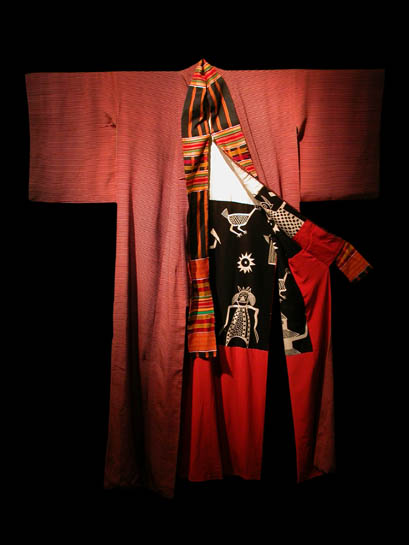 Dorothy Imagire
Kevin's Identity Garment, 1992
Vintage kimono and African fabric
After interviewing Sanseis, 3rd generation Japanese Americans who are also people of mixed Asian descent, Dorothy Imagire, an artist of Japanese and Iranian descent, blends fabrics from different cultures to create unique personalized kimonos reflecting each person's ethnic and cultural backgrounds. She will also be exhibiting, for the first time, her latest project - baby blankets reflecting the next generation of people of mixed Asian/Japanese descent-Quapa (or quarter Asian-Pacific American) children.
Dorothy Imagire has been creating photographs, installations, and garments about race, ethnicity and hybridity for her entire artistic career. Her works, like those of Fulbeck, are barometers marking the art public's interest in the now supposedly passe multiculturalism movement. Dorothy, like Kip, is Hapa, and I would include myself in that broad definition as someone of mixed Asian Ancestry. The most recent works of Dorothy's that I am familiar with are the beautiful Kimonos from her Mixed Identity Project. These stunning, contemplative textile works trace the Asian roots of the Sansei individuals for whom the garments are named. Dorothy's new work on exhibit at the Asian American Arts Centre continues in this vein. She has created textile works called "Quapa" Blankets, in which she uses textiles and other embellishments connected to the originating countries of the children of Hapa Sansei for whom the blankets are named.
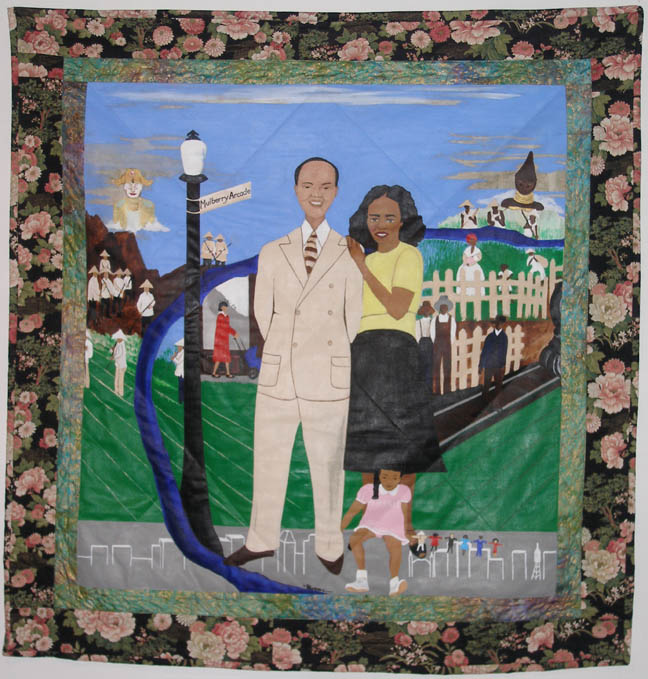 Toni Thomas
On Mulberry Arcade
acrylic on canvas, quilted,
2006
Dimensions: 43.75" x 45.5
Toni Thomas has been making quilts whose theme is the Chinatown that once was larger than that of New Yorks. Now a sports stadium is being built there and its last vestiges are being torn down. The history and rhythms of this old Chinese American community is depicted with great understanding and affection, and is built on a remarkable historical study of this Chinatown soon to be published by Yoland Skeete of the Sumei Multidisciplinary Arts Center that was located in the heart of this former community. Toni Thomas, of African American and Native American roots, shows the diverse relationships that took place in its old gathering locales, and the Afro-Asian couple who intermarried.
Don't miss this exhibition of the art of Kip Fulbeck, Toni Thomas and Dorothy Imagire
Albert Chong
Albert Chong is an Afro Asian Jamaican Artist based in Boulder, Colorado where he teaches at the University of Colorado. His works in photography and installation art has been exhibited nationally and internationally including AAAC in 1987, and is in Corporate and private art collections. He will take part in an exhibition at the California African American Museum in Los Angeles in Sept 2007.
Troung thi Kim Tuyen
True and natural beauty is a universal ideal, and positive terms that describe variations from this ideal are hard to find. Words like 'other', 'half', 'mixed', even 'Hapa', do not address the true reality of the whole person. Thus "mixed skin" people find themselves at the center of an unresolved racial inquiry. And at the core of every racial debate is the principle of universality, which goes far beyond the subject of ethnic borders.
Born to a Vietnamese mother and African-American Marine father in Viet Nam in 1972, I have lived in the united Statessince 1975. As an American citizen who is multi-ethnic and cross-culturally adopted, my cultural associations include much of what makes up America's "melting pot." While my association with African-American culture has been quite limited, people always want to place me in the African-American category. Art education and working as an artist have been the constants that define me. I respond to this "mixed skin" show as both an arts professional and an insider, who feels each artist's point of view.
The artists in the current art exhibition at the Asian American Arts Centre present blended cultural symbols created for multicultural understanding, making us pause to consider where mixed people come from as well as to ask where they might be taking us. Mixed Skin people pioneer new parameters for ethnic categories as well as for DNA.
Kip Fulbeck was born in 1965 to a Chinese mother and an English/Irish father. His lifetime of work has been dedicated both to exploring the identity of mixed race individuals and to reconstructing public perception of same by giving "Hapas" a public platform.The DNA of skin and the visible traces of multiracial tones found in Kip Fulbeck's Hapa photographs present a range of multiracial or mixed race persons created by contemporaryAsian culture and ethnic mixing. Fascinating revelations are offered by mixed skin people in their own words they tell us "what" they are. This is your opportunity to look deeply into the new Asian (American) paradigm of ethnic ownership. In the "real" world, perfect strangers feel entitled to ask mixed kids: What are you? Talking to a stranger about personal history or heredity is unwelcome and awkward for mixed skin people of all ages.
Dorothy Imagire's artwork explores cultural connections and disconnections of her own mixed Japanese-American/Iranian-American idenity. Through research and the art she makes exploring Asian-American issues, Imagire penetrates the symbolism related to the Japanese American culture she identifies with, and by means of her art, openly shares her personal identity search. Imagire's interviews with mixed skin (third generation) Japanese-Americans--a way to answer identity questions for herself-- produced "Bi-cultural Kimono." The kimono has been held in high esteem in Japanese culture as a symbol of beauty and ethnic pride. Made of traditional textiles and found fabric, each of Imagire's personally inspired garments is a product of her extensive interviews of these third generation mixed people and fabric construction techniques she learned from her Japanese tailor grandfather and Japanese seamstress grandmother. Dorothy Imagires Kimonos present a modern Japanese person, self-liberated, cutting into a traditional symbol of ancient Japan. Imagires work is both a fashion statement and a personal revelation for multicultural people. Next, Imagire applies this strategy to blankets for Quapa (socialogial term for quarter ethnic mixtures), baby blankets for the next generation--children of Imagire's modern Kimonos.
Toni Thomas rejects the concept of "Mixed Race," and classifies herself and others based on ethnicity. Thomas has two parents of African-American decent and calls herself African-American (with a bit of Native-American). In her fabric-backed paintings, she relates the historical perspective of the Chinese-American to that of the African-American. Thomas regards the Chinese immigrants who worked the railroad as the equivalent of the African-American field hands who planted and picked cotton. Chinese and African-American written expressions on her paintings make reference to a shared history of manual labor building the American nation. Thomas illustrates the shared migration from the field to the city by Chinese and African-American people by showing them side by side in American garments blended with cultural dress in urban environments. The viewer is made to understand that new levels of work and generational advancement in social status is a shared journey. Today in Newark's multi-cultural Chinatown, Chinese-Americans and African-American's live side by side, with mixed race couples, mixed skin kids dissolving the lines between Chinese-American heritage and Black American culture, and presenting a slice of culture that is distinctly American. Accordingly, Thomas has created a painting that illustrates a mixed culture environment rooted in African and Chinese history in America.
Meanwhile, as we sit in front of popular culture's big screen, mixed skin achievers like Tiger Woods redefine American racial self-identification standards and perceptions. Woods challenged America's media that categorized him as African-American and sometimes asked him what he was by making up a word for his mixed skin status, something long and hard to pronounce that included all of the cultures in his diverse family. Mixed skin Woods was telling people all over the world that he is beyond previous categories for cultural or racial classification. Today, high-profile cross-cultural marriages like that of Seal and Hedi Klum grace glossy magazines. Mixed skin superstar, Halle Berry, shows that fused culture/ethnicity can be celebrated as a symbol of beauty.
Globalization is happening. Does the face of the future's children belong to a world without borders? It is time for ethnic/cultural ambassadors or mixed people to have their say: We are human!
Troung thi Kim Tuyen
Troung thi Kim Tuyen was born in 1972, in Viet Nam. She holds a BFA degree from Howard University and numerous certificates of study from art schools in the US and London. Her photography has been exhibited in New York and London. And her painting/photography project "The Dust of Life,"has been exhibited at the United Nation with the support of the Permanent Mission of Viet Nam to the United Nation. She currently lives in New York City, where she works on marketing in the arts and entertainment industry.
[ close window ]